
How Decorative Medallions Enhance Both Form and Function in Window Treatments
Misti St. Pierre on Dec 29th 2025
Uses and Functions of Drapery Medallions | Window Treatment Hardware Guide
Introduction: More Than a Decorative Accent
Drapery medallions are often admired for their beauty, but their true value lies in how seamlessly they combine function and design. Used as curtain holdbacks, attachment points, or decorative wall accents, drapery medallions play a vital role in shaping how a window treatment looks, moves, and performs.
Unlike standard curtain hardware that relies solely on rods and brackets, medallions introduce flexibility. They allow homeowners and designers to control fabric placement, manage light, and enhance room decor coordination — all while serving as a visual focal point.
Understanding the uses and functions of drapery medallions helps clarify why they remain a preferred choice in both traditional and modern interiors.
Drapery Medallions as Curtain Holdbacks
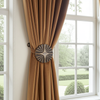
One of the most common uses of drapery medallions is as curtain holdbacks. When mounted on the wall beside a window, medallions act as an anchor point that allows curtains to be swept back and styled intentionally.
As holdbacks, medallions:
-
Open the window to maximize natural light
-
Frame the view without removing fabric
-
Create soft folds or structured swags
-
Add dimension to flat curtain panels
Compared to traditional curtain tiebacks or tassel holders, medallions offer a more architectural presence. Instead of relying on fabric loops or cords, the curtain is draped directly around or through the medallion, creating a sculptural effect that feels permanent and polished.
This makes them especially effective in formal living rooms, dining rooms, and primary bedrooms where visual structure matters.
Curtain Panel and Valance Attachment
Beyond holdbacks, drapery medallions can function as curtain panel attachments or curtain valance attachments. In these applications, the medallion replaces a rod entirely or works alongside one to secure fabric directly to the wall.
This approach is commonly used for:
-
Stationary curtain panels
-
Decorative side panels
-
Valances that do not need to open or close
-
Lightweight window treatments
Attaching fabric directly to a medallion allows for creative styling options, including pleated folds, gathered swags, and layered fabric arrangements. It also simplifies installation in spaces where a full rod may feel visually heavy or unnecessary.
For window scarves, medallions provide controlled draping points that prevent fabric from slipping while maintaining an effortless, cascading look.
Decorative Function and Room Coordination
Drapery medallions are as much about room decor coordination as they are about function. Because they sit at eye level, medallions naturally draw attention and help tie together other design elements in the space.
They often coordinate with:
-
Decorative finials
-
Curtain rods and brackets
-
Furniture finishes
-
Lighting fixtures
-
Architectural details such as moldings or columns
In farmhouse drapery hardware styles, medallions with simple profiles and textured finishes add warmth and character. In contemporary spaces, bolder shapes or mirrored medallions introduce contrast and visual interest. Traditional interiors benefit from classic forms that echo timeless architectural motifs.
Rather than fading into the background, medallions become intentional design features that elevate the overall window treatment.
Light Control and Fabric Management
Another practical benefit of drapery medallions is light control. By holding curtains in a fixed position, medallions allow homeowners to regulate how much light enters a room without fully opening or closing the drapes.
This is particularly useful for:
-
Sheer or semi-sheer curtains
-
Rooms with strong natural light
-
Spaces where privacy and brightness must be balanced
Medallions help maintain consistent fabric placement, preventing panels from drifting or bunching unevenly. This keeps the window treatment looking styled throughout the day without constant adjustment.
Medallions vs. Other Window Treatment Accessories
Drapery medallions are sometimes grouped together with wall hooks, knobs, or tiebacks, but their function is distinct.
-
Wall hooks are purely functional and typically minimal in design.
-
Curtain tiebacks rely on cords or fabric elements rather than structure.
-
Tassel holders emphasize softness but lack architectural presence.
-
Decorative finials cap rods rather than interact directly with fabric.
Medallions bridge the gap between form and function. They serve as a structural wall hook while offering the visual impact of decorative hardware. Here is our guide on medallions compared to other drapery hardware.
Versatility Across Window Treatment Styles
One of the greatest strengths of drapery medallions is versatility. They adapt easily to:
-
Formal drapery
-
Casual linen panels
-
Window scarf draping
-
Valances and top treatments
-
Stationary or operable curtains
This flexibility allows designers and homeowners to use the same medallion style across different rooms while achieving unique results through fabric choice and placement.
Final Thoughts: Function with Intentional Design
Drapery medallions are not simply decorative accents — they are functional tools that shape how window treatments perform and how spaces feel. By acting as curtain holdbacks, attachment points, and design focal elements, medallions offer a level of versatility unmatched by standard window treatment accessories.
When chosen thoughtfully, they enhance light control, improve fabric management, and contribute to cohesive room decor coordination. Whether used in farmhouse, traditional, or contemporary interiors, drapery medallions provide both structure and style.
Metropolis Iron specializes in handcrafted iron drapery medallions designed to balance durability, craftsmanship, and aesthetic versatility. Each piece is created to function as an integral part of the window treatment — not just an accessory — ensuring long-term performance and timeless appeal.